

Ever finished peeing, zipped up, and then—yikes—felt an unwelcome trickle down your leg? If you’ve experienced this, you’re definitely not alone. In fact, as a urologist, I hear patients share this complaint all the time, often with embarrassment or the assumption that something must be wrong with them. Here’s the reality: post-urination dribbling, or “post-void dribble,” is incredibly common and not merely a nuisance—it’s a clue about the health of your urinary system that you can do something about.
Let’s break down the why, the how, and the what now.
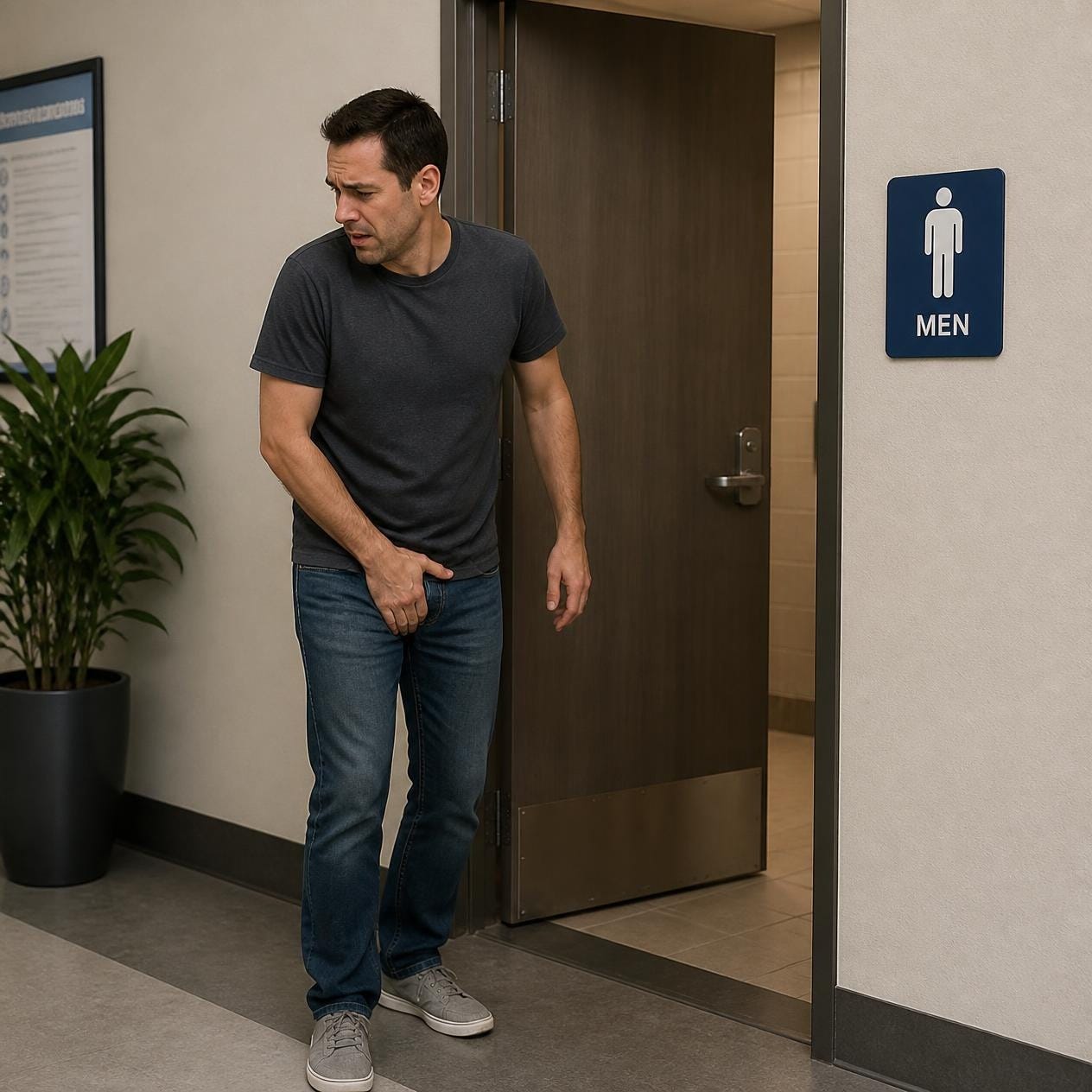
Why This Matters: It’s Not Just “Getting Older”
You might be surprised to learn that studies estimate anywhere from 5% to nearly 60% of men experience post-void dribble at some point in their lives—a statistic I bet still underestimates the true number. Many men chalk this up to “just aging” and, unfortunately, don’t bring it up with their doctors. But your bladder and prostate health are worth your attention.
What causes it? There isn’t a single answer—often, it’s a mix of factors related to your anatomy, muscles, and, yes, sometimes your prostate:
Urethral issues: A narrowing (stricture) can trap urine, which eventually leaks out after you’ve completed urination..
Prostate changes: As the prostate enlarges with age—a condition common in up to 80% of men over 70—urine can get trapped at the base of the penis, only to leak out once your sphincter relaxes.
Muscle or nerve function: The muscles that help “milk” the urine out (bulbocavernosus and ischiocavernosus) can become weaker, especially as we age or with certain neurologic conditions.
The Science (And The Frustration) Behind Dribbling
Here’s what actually happens, step by step:
Your bladder contracts: You urinate as usual.
The bladder neck closes: That’s the internal sphincter, shutting tight as you finish.
Sometimes, urine lingers: If not all the urine has cleared the prostatic section of your urethra, there’s leftover fluid trapped by the external sphincter.
You move, you relax, you leak: As soon as your external sphincter relaxes—bam—a dribble escapes!
Bothersome? Yes. Embarrassing? Sure. Fixable? Often—if you know what to do.
Step-by-Step Tips: Take Back Control of Your Stream
First: Let’s rule out more serious causes. If you experience the following, make an appointment with a urologist:
Weak or splaying urinary stream
Straining or pushing to pee
Stream that starts, stops, or requires waiting
Frequent or urgent bathroom trips, or waking up multiple times at night to urinate
These signs might point to a prostate issue or a urethral stricture, and the right treatment can address the dribbling at its source.
No Other Symptoms? Try These Evidence-Based Solutions
If your only issue is that post-pee dribble, you might benefit from “supportive” techniques that help clear out trapped urine. Here’s what works:
1. Bulbar Urethral Massage
After you finish urinating, use your fingertips about an inch behind your scrotum.
Gently push upwards toward the base of your penis, applying enough pressure to ‘milk’ any remaining urine forward.
Repeat once or twice—many find this prevents the dribble.
2. Shake, Stretch, or Squeeze
Gently stretch or shake your penis after urination to coax out lingering drops. (most guys already do this, I know!)
3. Strengthen with Kegel Exercises
Contract your pelvic floor muscles (imagine stopping your pee midstream—but don’t practice during actual urination).
Alternatively, “try to lift your penis up against gravity without touching it”.
Hold for 5 seconds, then relax for 5 seconds. Repeat several times, once or twice a day.
A word of caution: If you have pelvic pain, pain with ejaculation, or testicular pain, check with your doctor or pelvic floor therapist before starting Kegels.
Real Talk: You’re Not Alone, and It’s Fixable
In my practice, patients often assume they’re the only ones dealing with this. The truth? Millions of men struggle with post-void dribble—and most can improve or even eliminate it with small but consistent habits. There’s nothing shameful about this issue, and addressing it can not only save you a little laundry, but also enhance your confidence and comfort each day.
Ready for More Evidence-Based Tips? Subscribe for Weekly Urology Wisdom!
If you found this useful, subscribe for weekly educational content on pelvic health, prostate wellness, and real-life solutions to common urologic concerns.
Your questions drive this community: What’s YOUR biggest pelvic or bladder health question? Share it in the comments—I want to hear from you!
Join our growing circle of savvy, health-focused readers. Hit subscribe for exclusive, science-backed content to keep you healthy, confident, and in control.
If you’d like to catch the full conversation:
Just entered the shady side of 80; I had the whole list of old man BPH problems. The PCP, I’m on a Health Care advantage plan, refuses to refer me to urology; told me the solution is simple, told me I too old to waste a valuable resource like a specialist on. I was able to blow beat another provider into giving me the consult to urology. The urologist solved the problem of BPH inside of 30 minutes. I now sleep through the night, no longer dripping urine, no longer have unexpected urination. I now question why the PCP didn’t follow the organization’s pathway which outlined the solution to my problems. Back to Original Medicare.
Thank you , for the great insight